



sealants
CHOOSING A SEALANT
Under the perfect conditions, most sealants will perform proficiently to keep parts in place or to restrict air and liquids from escaping/entering. Unfortunately, perfect conditions are rare in many industrial situations and when temperatures start climbing, pressure increases as well.
In order to avoid dangerous and costly situations, it is crucial to use the correct sealant in high temperature and pressure applications.
What makes selecting the correct sealant such an exact science is that temperature isn’t the only determining factor. PSI, chemicals, and function are all important details that must be accounted for when selecting the appropriate sealant.

Temperature
In high-temperature applications, it is imperative to select a sealant for both the operating temperature as well as the maximum temperature it can reach. For example, a home furnace usually runs at roughly 60-70° but is probably capable of reaching 90°+.
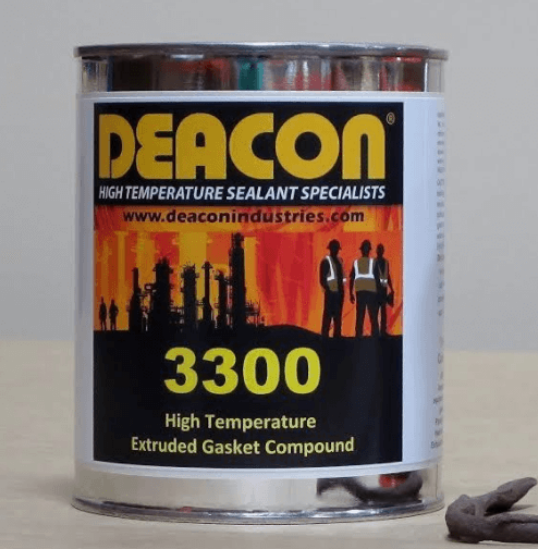
Sealant degrades in high-temperature situations so it is important to select a product that can take the heat. Our 3300 and 8875-Thin Sealants are excellent products to be used for higher temperature applications.
Chemicals
Along with temperature and PSI, chemical exposure is another key factor in determining which product to use. Our 3100 sealant is designed to have excellent chemical resistance to ammonia, steam, oils, hydrocarbons, solvents, propane, etc.
CHOOSING A SEALANT
Under the perfect conditions, most sealants will perform proficiently to keep parts in place or to restrict air and liquids from escaping/entering. Unfortunately, perfect conditions are rare in many industrial situations and when temperatures start climbing, pressure increases as well.
In order to avoid dangerous and costly situations, it is crucial to use the correct sealant in high temperature and pressure applications.
What makes selecting the correct sealant such an exact science is that temperature isn’t the only determining factor. PSI, chemicals, and function are all important details that must be accounted for when selecting the appropriate sealant.

FOR PERFORMANCE
Our 3300 and 8875-Thin are both great products that can be used to increase the efficiency of furnaces by retaining heat as well as sealing combustion and dirt. These are typically low PSI situations but with high temperatures.
We realize that every application is different and may fall into one or more of these four categories. Most situations will involve a slight mix of high temperatures, chemical exposure, pressure, and performance while other elements such as surface texture and material are also deciding factors. It is important to consider all of the working variables before choosing which high-temperature sealant may be right for your application. AccuTrex is happy to give you hands-on advice for selecting the perfect product and we are standing by for assistance.
TYPES of sealants include:
Deacon 3100 is (200°F to 950°F) – This is another high temperature extruded gasket compound, which is stronger, more durable, and more flexible than ceramics or mortars, and features high chemical tolerance, fast and easy repairs, and compatibility with thermal cycling.

Deacon 3300 (600°F to 1600°F) – This high temperature extruded gasket compound is ideal for extreme temperatures. It maintains its pliability and can be used to fill voids, pits, and steam cuts on flanges. It is a heat curing, compressible, joint sealant that conforms to flange face and gap irregularities better than standard die cut gaskets
Deacon 770-L (200°F to 950°F) – This is a thermal-reactive, sealing compound for gasket dressings, threads, and metal-to-metal applications. It is well suited for high-temperature and high-pressure environments, such as liquors, hydrocarbons, steams, and solvents. It acts as a mechanical-type seal in the presence of heat and does not interfere with future repairs of metal-to-metal joints.
Deacon 8875-Thin (150°F to 1800°F) – This is a heat curing fibered paste used in high-temperature flange, thread, and gasket dressing applications. It is a refractory/sealant hybrid that does not become weak or brittle and is compatible with thermal cycling. It is typic